
Henan Ceramics wares (河南陶瓷)
Northern Dynasty/Sui Period
Lead glaze wares
Henan is one of the regions in China where Neolithic pottery was first discovered. In 1921, neolithic painted pottery was recovered in Yangshao (仰韶) village in Mianchi (渑池) county. In addition, a number of sites producing the Longshan culture black pottery wares were also subsequently discovered. This tradition of pottery production persisted and the Henan potters also subsequently learnt the technology of lead glazing for its products. Green lead glazed pottery is widely believed to have originated in Guanzhong (关中)in Shanxi (陕西) during the Western Han period.
The potters also introduced new decorative technique to improve the asesthetic of the wares. Some interesting examples were excavated in the Luoyang (洛阳) city, a Northern Wei period site. For example, the below fragment of a bowl showed some area of the reddish earthen body decorated with white slip. The bowl was then covered with a light green lead glaze. The decorative style showed distinct influence of vessels from the Central Asia.
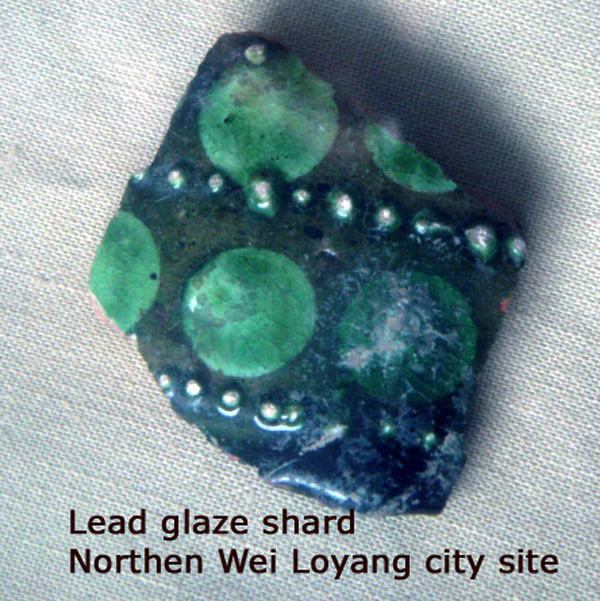
The assimilation of certain degree of culltural elements from the western region was grounded in historical development after the collapse of Western Jin. Northern China was invaded by the 5 Barbarians (五胡) who established their own kingdom in the 4th centuries. The peoples categorized as the Five Barbarians are the Xiongnu, Jie, Xianbei, Di, and Qiang. They were a mix of tribes comprised mainly of Mongolian, Turkic and Tibetan stock. Eventually, the Northern Wei of the Xianbei stock conquered the rest of the northern states in 386. It was the beginning of the Northern Dynasty, which lasted till 581 A.D. It went through 5 Dynastic changes and finally united with South China under Sui Dynasty. During the reign of emperor Xiaowen of Northern Wei (reigned 471–499), he instituted a Sinicization program. His father was a Xianbei and mother was Chinese. There was widespread social and cultural transformation. These social reforms included wearing Chinese clothing, learning the Chinese language, applied one-character Chinese surnames to Xianbei families, and encouraged the clans of high-ranking Xianbei and Chinese families to intermarry. Emperor Xiaowen also moved the capital city from Pingcheng to one of China's old imperial sites, Luoyang, which had been the capital during the earlier Eastern Han and Western Jin dynasties. There were increased contact with Central Asia and mutual trade and cultural exchanges. The adoption of Central Asian form and decorative elements in Chinese ceramics is a testament of the exchanges. It was a milestone period which saw greater openness and willness to accept, experience and assimilate foreign cultural elements in the daily lives of the people. It set the stage for increased cultural exchanges and finally the transformation of Chang an into the most cosmopolitan city during the Tang Dynasty. It was during the Tang Dynasty which we saw the greatest artistic influence of Central and middle East on Chinese art forms, including ceramics wares.
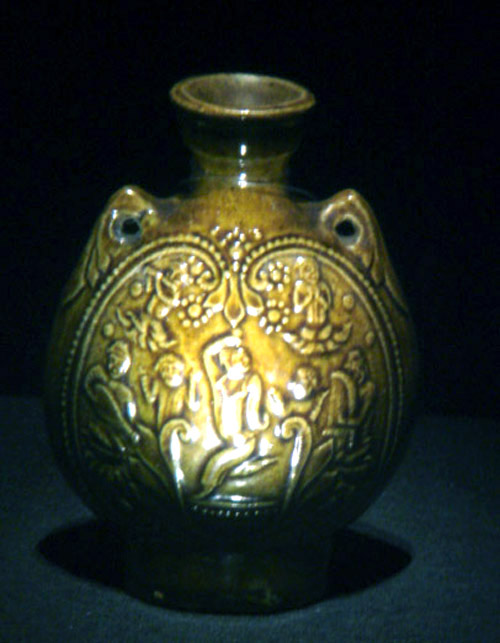
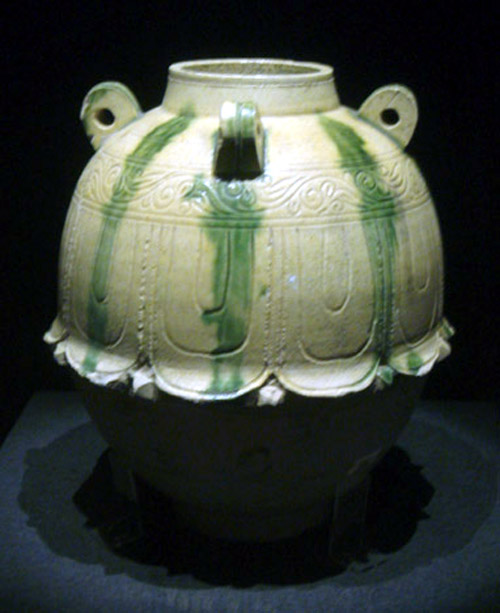
Sometime during the Northern Dynasty, the Henan potters also learnt the technology to make ceramics from porcelaineous material. This required the vessels to be fired to around 1100-1200 degree centigrade instead of 800-1000 degree centigrade for pottery. The potters also found new use for the lead-glaze technology. Instead of the reddish earthernware body, the lead glaze was applied on white porcelaineous white body material. The final product required two firing processes. Firstly, the biscuit was fired to around 1100-1200 degree centigrade. Lead glaze was then applied and the vessel went through a second firing of around 900-1000 degree centigrade. Besides the traditional lead green or amber monchrome glaze, a new transparent straw white glaze was introduced. Some of the straw white glaze vessels were further decorated with green lead-glaze splashes. A number of elaborately decorated lead-glaze vessels were found in tombs of the the Northern Dynasty Beiqi (北齐) period. The form of the vessels showed strong Central Asian influences. Two examples, one an amber glazed flat hu vase from the tomb of Fancui (范粹) and a light straw colour glazde jar with green splashes from the tomb of Li Yun (李云) are shown below. The former has impressed decoration of Central/midde Eastern looking musicians and dancers. The latter has protruding lotus petals which is distinctly Buddhist influenced. This light straw colour glazde jar with green vertical splashes was the precursor of the Tang Sancai wares.
 |
 |
Green and White Glaze Wares
Despite its long history of pottery productions, Henan and other famous Neolithic pottery production regions in Northern China did not progress to produce proto-porcelains. Although many proto porcelains of the Shang/Zhou period were discovered in Henan, the chemical analysis pointed to a Southern China origin of production. In fact, very few proto-porcelains/porcelains were found in nobility tombs in Henan spanning the warring states to the Jin period.
Archaeological excavations showed that porcelain with green glaze was first produced during the Northern Dynasty period in regions such as Shangdong, Hebei and Henan. The green glaze ware of Northern China is visually different from that made in Southern China. The glassy glaze is more transparent with grayish green or yellowish brown colour tone.
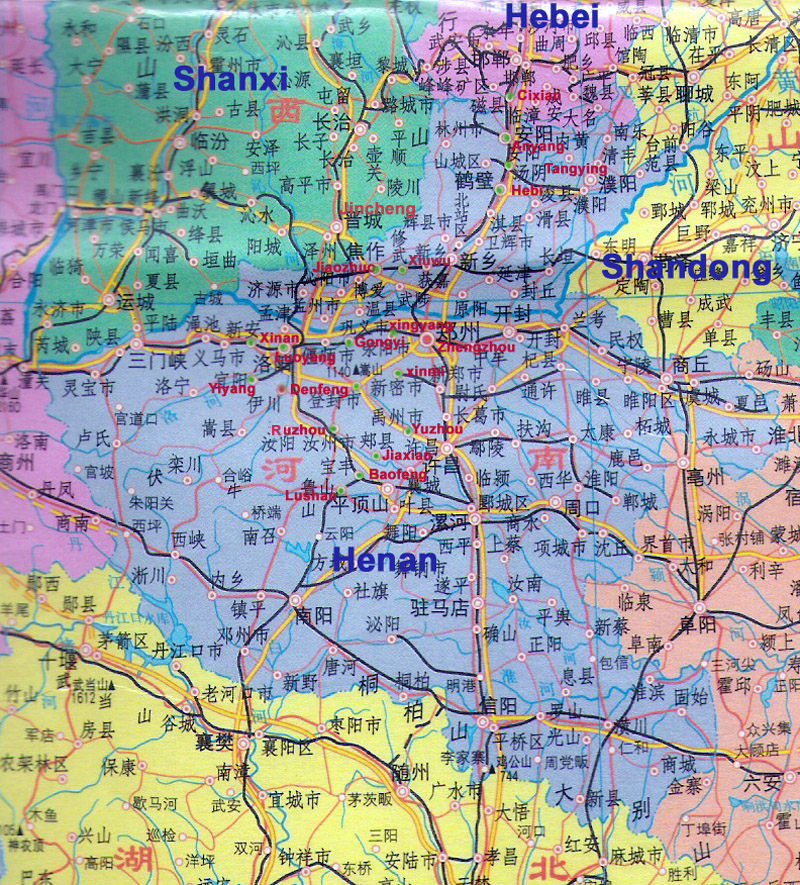
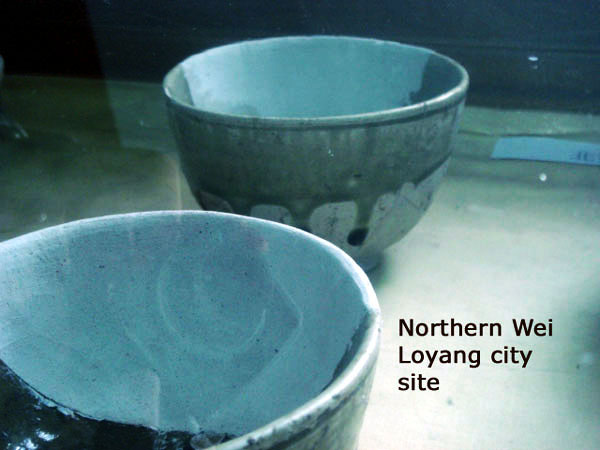
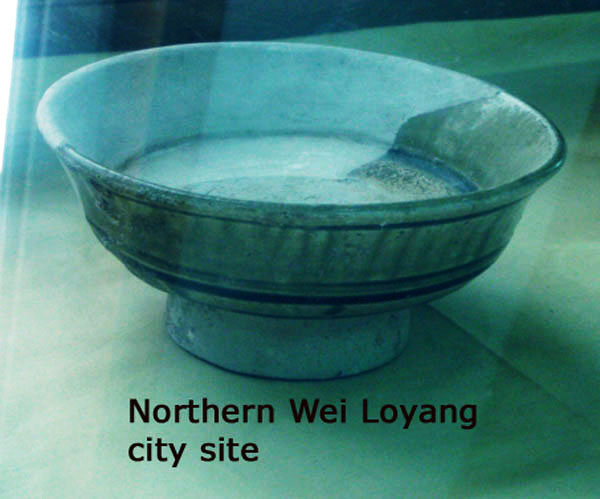
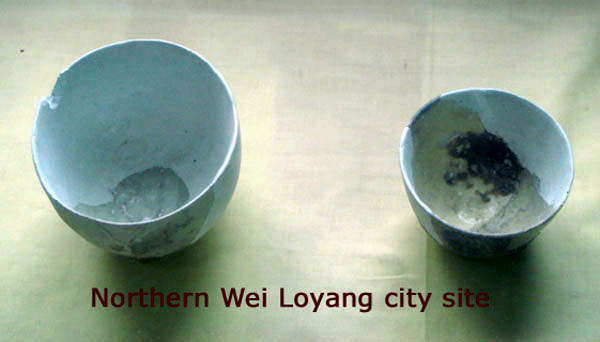
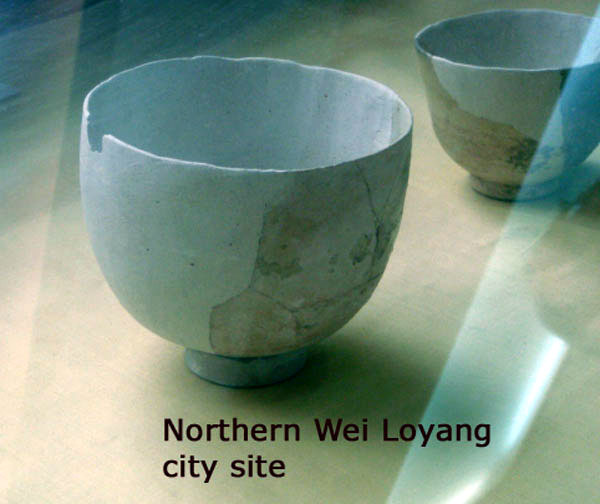
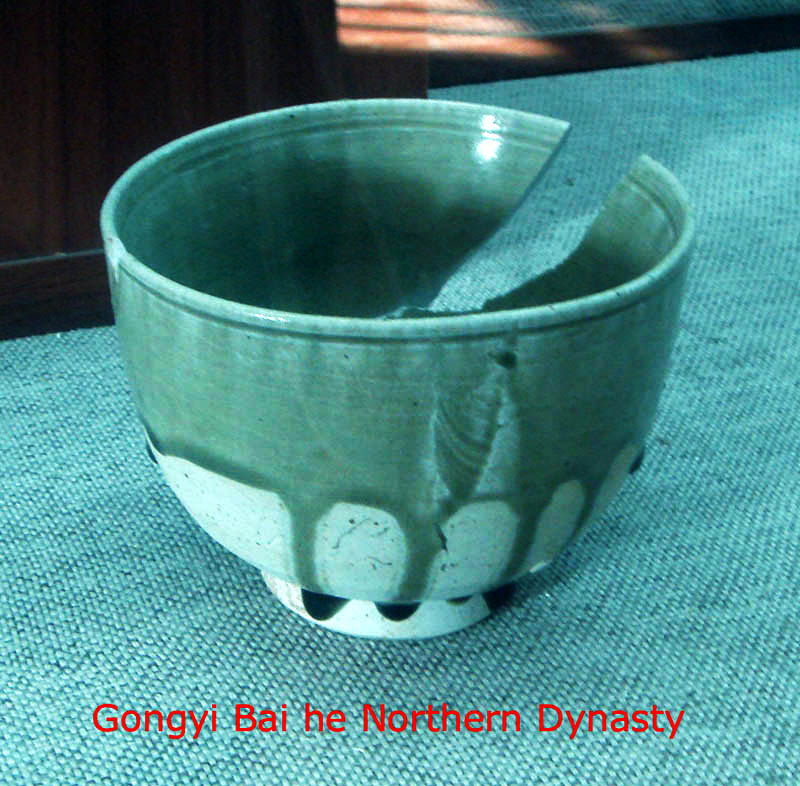
Green and white glaze wares were excavated from the ancient Luoyang city stratum of the late Northern Wei period. Some were attributed to the Gongyi (巩义) Baihe (白河) kiln. Some kiln rejects from Gongyi showed white glaze bowls/cups placed at the top of green glaze bowls/cups. They were separated by three-prong spurs. The paste of the white wares were more fined grained and whitish in colour. They were also more thinly potted. The white glaze still shows tinges of green especially in area where the glaze pooled. Some ceramics experts however expressed reservation regarding the findings in Luoyang city and felt that more archaeological evidences must be gathered to establish firmly that white wares already existed during the Late Northern Wei/Eastern Wei period. Furthermore, they noted that no white wares from Northern Wei/Eastern Wei have been found in tombs/graves. The shape of the bowls/cups from Luoyang site was also similar those found in Sui Tombs/graves. However cups/bowls are probably not a good and problematic dating guide because the shape apparently did not gone through marked changes from the Northern Wei to Sui period.
 |
 |
 |
 |
 |
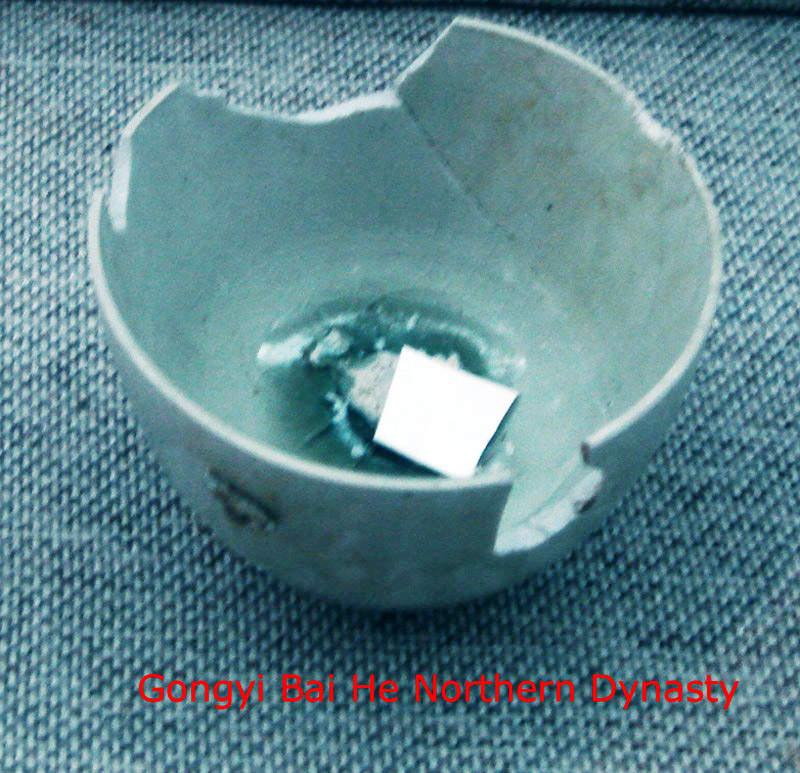 |
| Baihe Green glaze cup | Baihe white glaze cup |
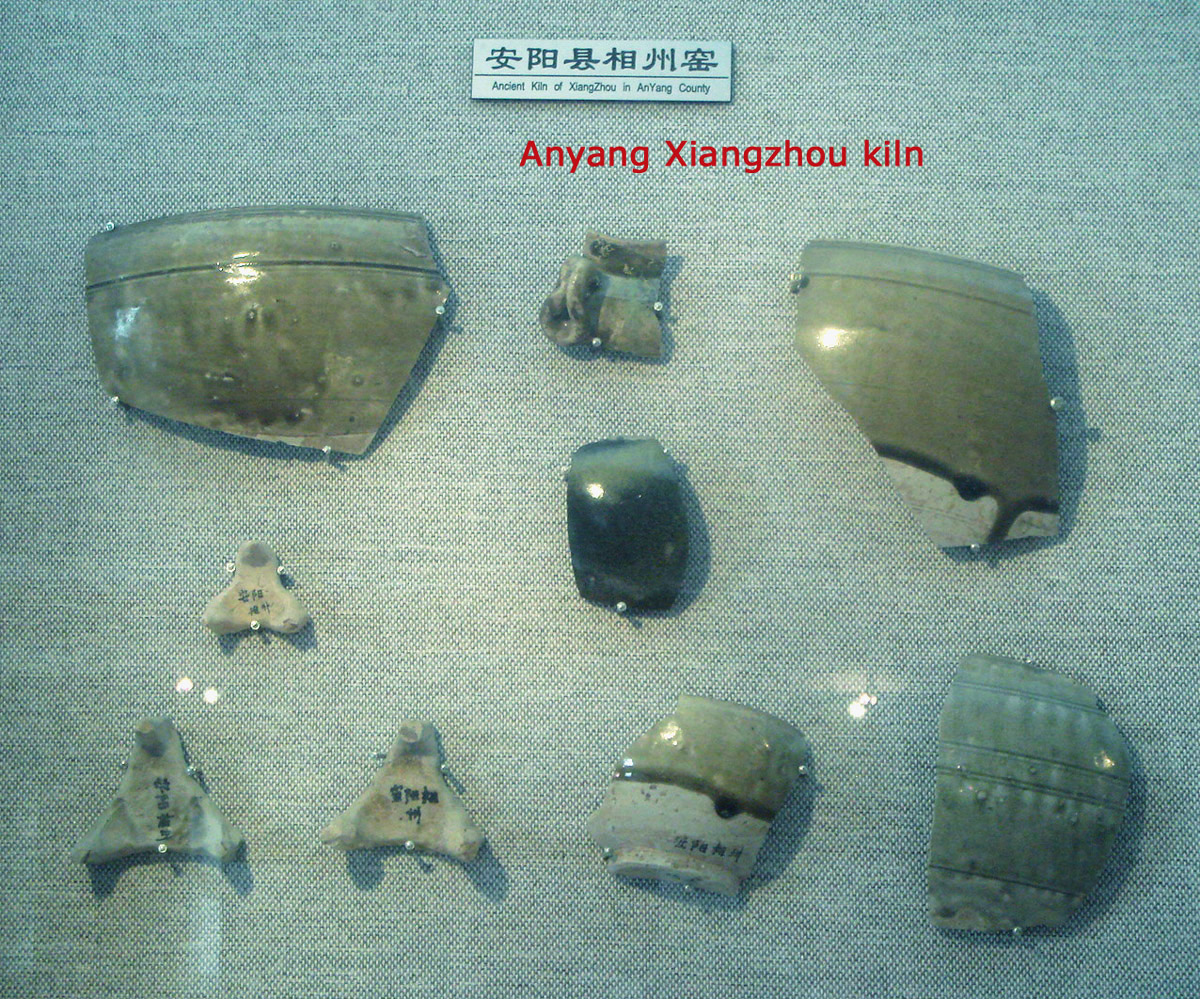
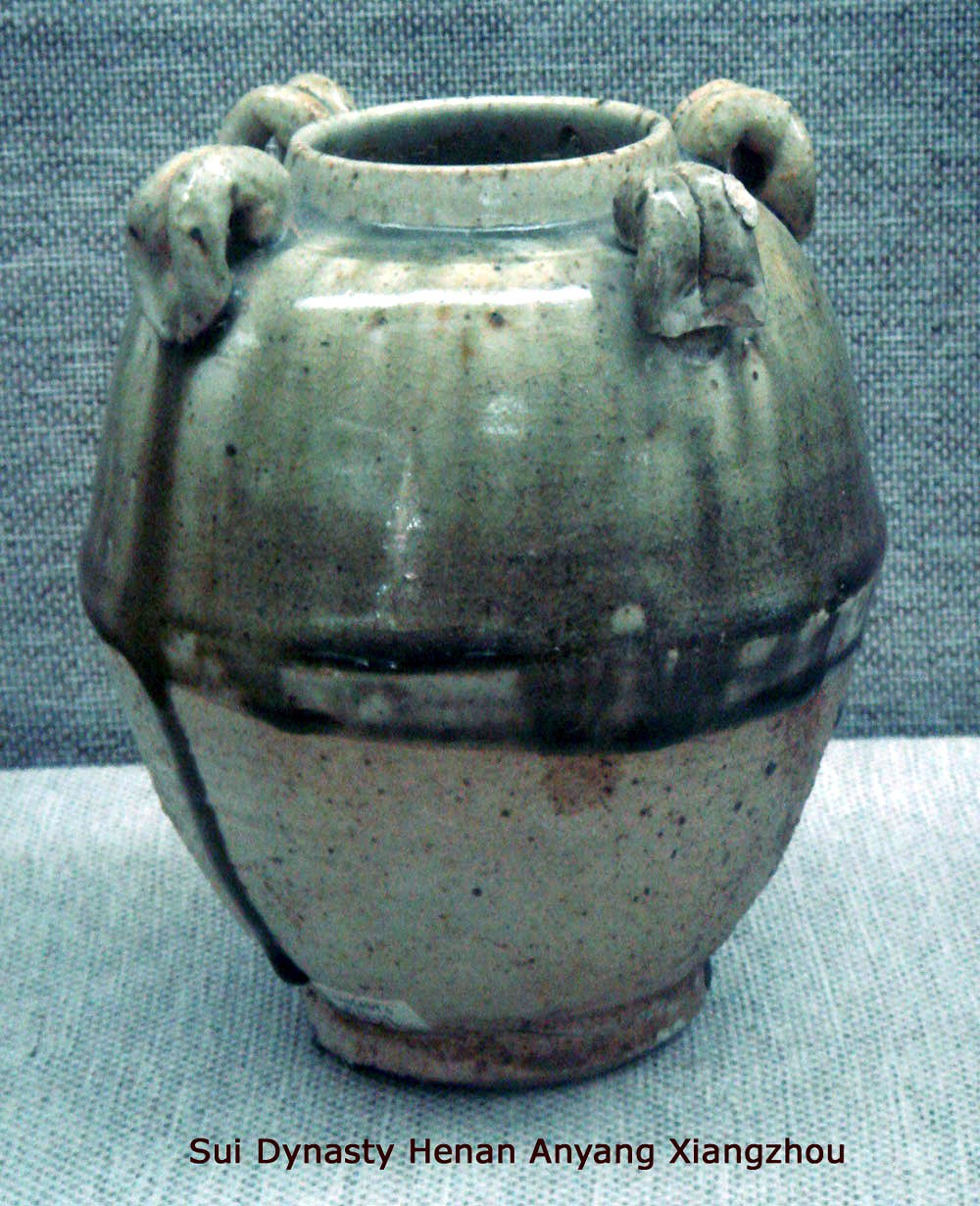
Another site that produced Northern Dynasty to Sui period green glaze wares in Henan was Anyang Xiangzhou (安阳相州) kiln. In the below photo, picture of the 3 prong spurs is illustrated on the lower left. The wares of these Northern Dynasty/Sui period were fired without the use of saggars to protect the vessels.
 |
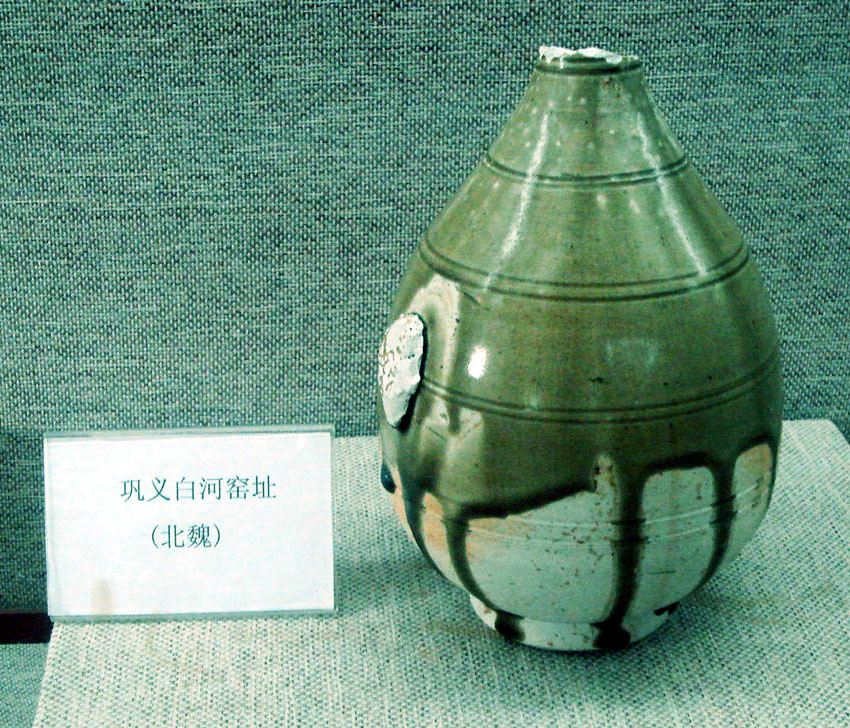
Attributed to Bei Wei Baihe (北魏白河窑) kiln |
Continue to Page 2
Written by : NK Koh (26 May 2010)
References:
1. 中国陶瓷史 - 中国上海硅酸盐学会编
2. 中国古陶瓷研究 (第十五集) - 中国古陶瓷学会编